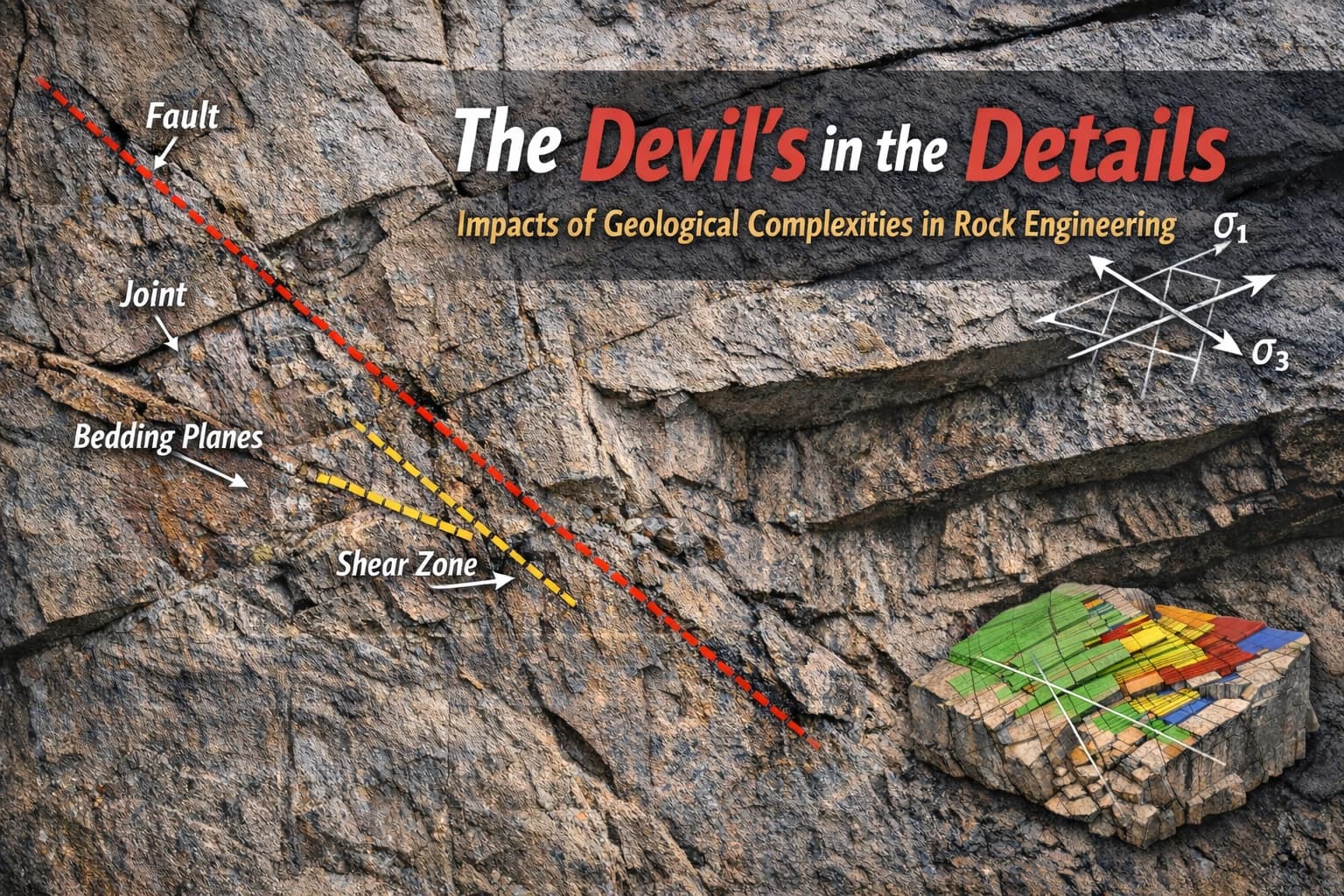
The 2025 CGS Colloquium Lecture: The Devil’s in the Details - Impacts of Geological Complexities in Rock Engineering
About The Speaker
Jennifer J. Day
( Queen's University)
Jennifer Day is an Associate Professor in the Department of Geological Sciences and Geological Engineering at Queen’s University, and a Board member of private and not-for-profit corporations. She is a Geological Engineer with registration as a Professional Engineer (PEng) and Professional Geoscientist (PGeo) in both Ontario and New Brunswick. She received a BASc in Geological Engineering, BA in Music, and PhD in Geological Engineering from Queen’s University, as well as an MBA from the Ivey School of Business, Western University. She is honoured to be the first Canadian to receive the Richard Wolters Prize from the International Association for Engineering Geology and the Environment (2022) for meritorious scientific achievement by a young engineering geologist (under 35) and first Canadian to receive the Dr. N.G.W. Cook PhD Dissertation Award from the American Rock Mechanics Association (2017). She has served as President of the Canadian Rock Mechanics Association, as well as the Divisions and Committees Representative on the Executive Committee and Chair of the Rock Mechanics Division of the Canadian Geotechnical Society
Abstract
Rock engineering is a discipline tasked with the challenge of working with relatively little information about the natural and often highly variable geological materials on and through which infrastructure projects are designed and constructed, or to which the public is otherwise exposed. Translating the expected geomechanical behaviours of intact rock, geological discontinuities, and rockmass systems to quantitative classifications with associated empirical recommendations for ground support or slope design is a well-established process in rock engineering. Numerous constitutive models with inputs from field rockmass characterization systems and/or geomechanical laboratory testing have been developed for numerical-based rock engineering analyses and design. These tools include relatively simple considerations of geology and can be insufficient in scenarios where geological heterogeneities, anisotropies, and other complexities control rockmass stability. There are many examples of engineering projects where ground behaviours involving geological complexities have unfortunately led to extremely costly delays or casualties.
At its core, my research team’s and my work aims to transform our understanding of geologically complex rock damage evolution and rockmass stability performance, thereby providing insights and tools to improve protection of worker and public safety as well as economic success for civil and mining infrastructure development and geotourism. This work is at the intersection of geological engineering (specifically geomechanics, geotechnics, engineering geology, rock engineering, and geohazards) and geological sciences (mineralogy, structural geology, petrology, sedimentology, stratigraphy, and geochemistry). Examples of complex geologies addressed by our research include healed hydrothermal veins and nodular meso-scale sedimentary rockmass structures (collectively termed intrablock structures), clast-based lithologies such as conglomerates and breccias, non-parted anisotropies such as sedimentary or volcanic bedding and metamorphic foliations, and anisotropic roughness on parted discontinuities.
Our work has developed innovations in fields characterization techniques, advances in laboratory testing methods, and expansion of numerical modeling tools to provide insight to rock and rockmass performance in several contexts, including mining, tunnelling, deep geological repositories for long-term nuclear waste storage, and shoreline cliff and sea stack geotourism. Collectively, these contributions provide pathways to integrate complex geological realities into various components of site investigation, laboratory tests, and numerical models for rock engineering. This 2025 Colloquium Lecture and Paper will highlight key aspects of these works
Wed, 25 Feb 2026 - 11:30 AM
Registration ends at:
Mon, 23 Feb 2026
Gold Sponsors